
Choosing the right way to watch television has become more complicated than ever. UK viewers now have access to traditional TV, streaming platforms, live television services and internet-based entertainment. That makes IPTV vs Netflix an interesting comparison for anyone looking for better value, more flexibility or a wider choice of content.
Netflix is one of the UK’s most established streaming services, offering an extensive on-demand library of films, series, documentaries and original productions. IPTV, meanwhile, can provide television channels and on-demand content over an internet connection, depending on the service and its licensing.
According to Ofcom’s latest 2026 Media Nations findings, 26% of UK viewers say Netflix is their first choice when looking for something to watch, putting it almost level with the BBC at 25%.
So, which option is better? The answer depends on what you watch, how you watch it and how important live TV, content variety, simplicity and legal certainty are to you.
What Is IPTV?
IPTV stands for Internet Protocol Television. Instead of receiving television through traditional terrestrial, satellite or cable broadcasting, IPTV delivers television content through an internet connection.
The technology itself is not illegal. Legitimate IPTV services can provide live channels, catch-up television and on-demand programming over the internet.
IPTV may be available through:
- Smart TVs
- Android TV devices
- Amazon Fire TV devices
- Apple TV
- Smartphones and tablets
- Computers
- Compatible set-top boxes
However, there is an important distinction between legitimate IPTV services and services that distribute copyrighted television channels without permission.
The UK government explains that streaming devices are legal when used for legitimate content, but become illicit when adapted to access copyrighted films, television programmes or subscription sports channels without the appropriate permission or subscription.
This distinction is essential when considering IPTV vs Netflix.
What Is Netflix?
Netflix is a subscription video-on-demand platform. Rather than providing a traditional television channel package, Netflix gives subscribers access to a catalogue of films, television series, documentaries and Netflix-produced content.
Its biggest strength is convenience. You can choose a programme and start watching it whenever you want, without waiting for a scheduled broadcast.
Netflix is particularly attractive to viewers who enjoy:
- Original series and films
- On-demand entertainment
- Personalised recommendations
- Multiple profiles
- Subtitles and audio options
- Watching across different devices
- Simple, beginner-friendly interfaces
Ofcom reported in 2025 that Netflix was present in 17.4 million UK households, equivalent to around 59% of UK households, making it the UK’s most-subscribed major subscription video-on-demand service.
IPTV vs Netflix: The Main Differences
When comparing IPTV vs Netflix, the biggest difference is the type of viewing experience.
Netflix is primarily designed around on-demand entertainment. IPTV can be designed around live television, depending on the provider.
Live TV
This is one of the biggest advantages of legitimate IPTV services.
Some IPTV platforms provide live television channels, making them more similar to traditional TV.
Netflix is different. It has historically focused primarily on on-demand content, although it has expanded into additional types of programming and live events.
If your priority is watching scheduled television channels, a legitimate live-TV IPTV service may be more suitable.
On-Demand Content
Netflix has a major advantage when it comes to a straightforward on-demand experience.
You can browse its catalogue, search for a title and begin watching almost immediately.
Many IPTV services can also include video-on-demand libraries, but the quality, size and organisation of those libraries can vary considerably between providers.
For viewers who mainly watch films and series, Netflix is often the simpler choice.
Content Variety
Another important factor in IPTV vs Netflix is content variety.
A legitimate IPTV package may offer numerous live channels, including entertainment, news, documentaries and potentially sports channels, depending on the provider’s licences.
Netflix concentrates more heavily on films, series, documentaries and its own productions.
Therefore, the “better” option depends on whether you prefer channel variety or on-demand library depth.
IPTV vs Netflix: Which Is Better for Live Sports?
For sports fans, the comparison becomes more complicated.
Netflix is not designed to replace every traditional sports broadcaster. Some live sports and events may be available, but availability changes over time and depends on the country and Netflix’s current agreements.
A legitimate IPTV or internet TV service can be more suitable if it provides authorised access to live sports channels.
However, viewers should be careful when searching for cheap IPTV subscriptions that promise every premium sports channel for an unusually low price.
The UK government specifically warns that illicit streaming can involve access to subscription sports channels without paying the appropriate subscription.
Tip: Before subscribing to any IPTV provider, check whether it has the necessary rights to distribute the channels and content it advertises.
IPTV vs Netflix: Price and Value
Price is another major reason people compare these services.
Netflix uses subscription plans, with pricing and features depending on the plan available in the UK. You can check the latest official plans through the Netflix Help Centre.
IPTV pricing varies enormously because “IPTV” is a technology rather than one single service.
You may find:
- Free legitimate services
- Broadcaster streaming services
- Paid live-TV platforms
- Telecom TV packages
- Unlicensed services
The cheapest option is not automatically the best option.
A suspiciously cheap subscription offering hundreds or thousands of premium channels may create legal, reliability and security concerns.
When evaluating IPTV vs Netflix, consider the total value rather than the monthly price alone.
Ask yourself:
- How many hours do I watch television each week?
- Do I mainly watch films and series?
- Do I need live channels?
- Do I watch sports?
- Do I need multiple household profiles?
- Is the service properly licensed?
- Does it work reliably on my devices?
IPTV vs Netflix: Device Compatibility
Both IPTV and Netflix can work across a wide range of devices, but the experience depends on the specific service.
Netflix is generally straightforward because its applications are widely supported.
You can commonly watch Netflix using:
- Smart TVs
- Streaming sticks
- Tablets
- Smartphones
- Laptops
- Gaming consoles
- Web browsers
Legitimate IPTV services can also support many of these devices, although compatibility varies by provider.
Before purchasing an IPTV subscription, check whether the provider officially supports your particular Smart TV, streaming device or mobile platform.
IPTV vs Netflix: Ease of Use
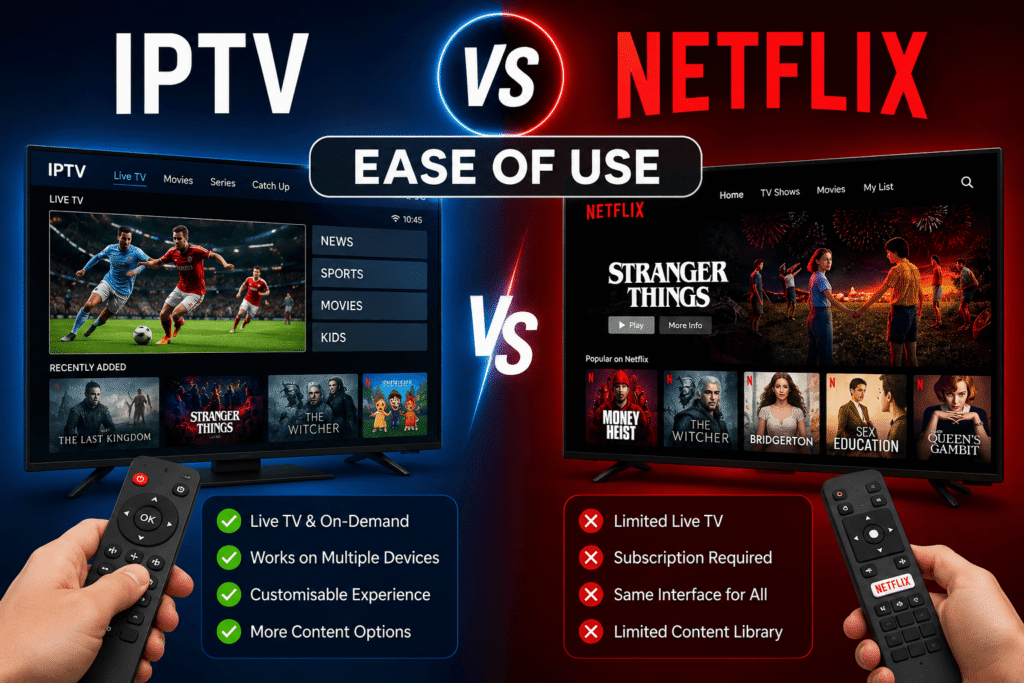
For beginners, Netflix has a significant advantage.
Its interface is designed around simple navigation. Search for a programme, select it and start watching.
Some IPTV applications can be more complicated. Depending on the service, users may need to configure playlists, accounts or other settings.
This does not necessarily make IPTV bad. It simply means the experience can vary more from one service to another.
For someone who wants simple streaming without technical configuration, Netflix is usually easier.
For a viewer who wants more control over live channels and television-style viewing, a legitimate IPTV platform can be more appealing.
IPTV vs Netflix: Streaming Quality
Streaming quality depends on several factors, including:
- Internet speed
- Wi-Fi performance
- Device capability
- Server capacity
- Video resolution
- Network congestion
- Provider infrastructure
Netflix has invested heavily in its streaming infrastructure, giving users a relatively consistent experience.
With IPTV, quality can vary significantly depending on the provider.
A reputable, licensed service should provide reliable infrastructure and clear information about supported resolutions.
If an IPTV service frequently buffers, disconnects or changes servers, the advertised channel count becomes much less important.
IPTV vs Netflix: Reliability
Reliability is one of the most overlooked factors in this comparison.
A legitimate streaming service should provide a predictable user experience.
With Netflix, the service is centrally managed, meaning the interface, account system and content catalogue are controlled by Netflix.
With IPTV, reliability depends heavily on the provider.
Potential problems with questionable IPTV services can include:
- Channels suddenly disappearing
- Frequent buffering
- Servers becoming unavailable
- Poor customer support
- Unclear subscription terms
- Services disappearing entirely
That is why consumers should research a provider before paying for a subscription.
Legal Considerations for UK Viewers
Legal considerations are particularly important when comparing IPTV vs Netflix.
Netflix is a mainstream licensed streaming platform. IPTV itself, however, is simply a method of delivering television over the internet. The legality depends on what content the provider distributes and whether it has the appropriate rights.
The UK government states that illicit streaming means watching copyrighted content without the copyright owner’s permission, regardless of whether the content is accessed through a device, application or another method.
A useful rule is simple:
If a service offers copyrighted premium content without appropriate authorisation, avoid it.
Do not assume that an IPTV subscription is legitimate simply because it works on a Smart TV or streaming stick.
Ofcom is also increasing its oversight of major video-on-demand services under the UK’s Media Act framework. In 2026, Ofcom announced proposed new protections covering major streaming platforms, including Netflix.
IPTV vs Netflix: Which One Should You Choose?
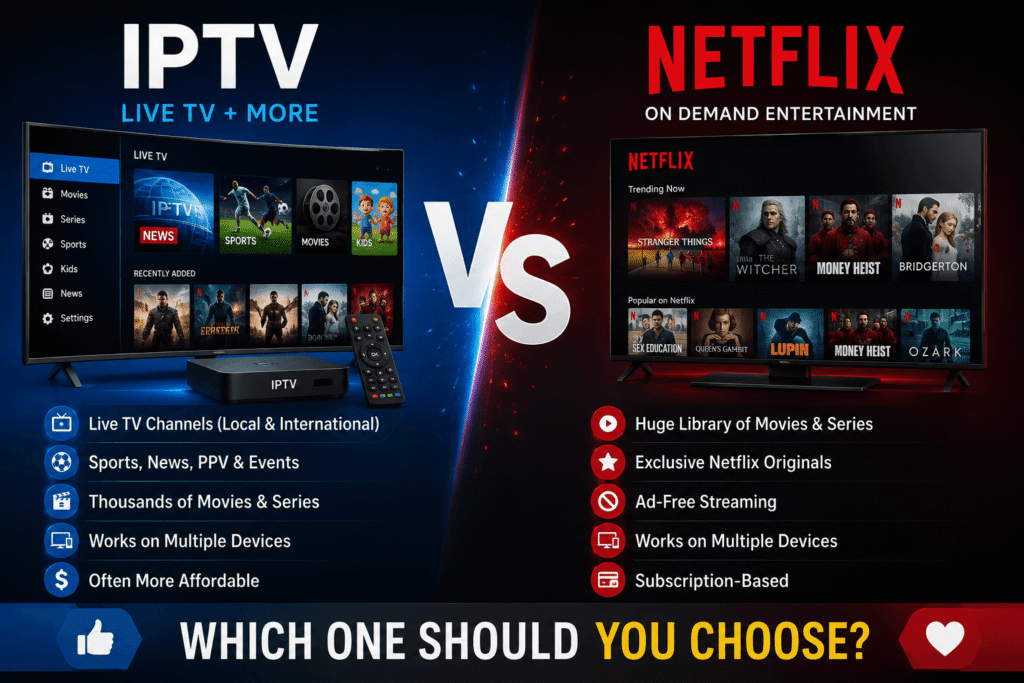
The best choice depends on your viewing habits.
Choose Netflix if you:
- Mainly watch films and TV series
- Want Netflix Originals
- Prefer an easy interface
- Want personalised recommendations
- Prefer on-demand viewing
- Want a familiar mainstream service
Consider a legitimate IPTV service if you:
- Prefer live television
- Want a traditional channel-style experience
- Need specific authorised live channels
- Want live programming alongside on-demand content
- Are comfortable checking provider details and compatibility
Consider using both
For some households, there is no need to choose only one.
You could use Netflix for films, series and original programming while using a legitimate live-TV service for channels, news or authorised sports coverage.
This can provide a more complete entertainment setup without relying on questionable services.
How to Choose a Safe IPTV Service
If you decide to explore IPTV, take a few minutes to investigate the provider.
Look for:
- Clear company information
- Transparent pricing
- Terms and conditions
- Privacy information
- Legitimate content licensing
- Official applications
- Reliable customer support
- Clear refund policies
Be especially cautious of providers advertising huge numbers of premium channels for extremely low prices.
Avoid services that encourage you to bypass subscriptions or access premium channels without authorisation.
Frequently Asked Questions
Is IPTV better than Netflix?
There is no universal winner in IPTV vs Netflix. Netflix is generally better for simple on-demand films and series, while a legitimate IPTV service may be better for viewers who prioritise live television.
Is IPTV legal in the UK?
IPTV technology is legal. The important issue is whether the provider has permission to distribute the content. Unauthorised distribution or access to copyrighted programming can be illegal.
Is Netflix an IPTV service?
Netflix uses internet-based streaming, but it is normally described as a subscription video-on-demand service rather than a traditional IPTV provider.
Can I use IPTV and Netflix together?
Yes. They serve different purposes, provided that the IPTV service you use is legitimate and properly licensed.
Which is cheaper, IPTV or Netflix?
It depends on the service. Netflix has clearly defined subscription plans, while IPTV prices vary widely. A low-cost IPTV service is not necessarily better value if it is unreliable or unauthorised.
Which is better for UK sports?
A legitimate live-TV or sports streaming service may be more suitable for particular sports than Netflix. Always check current broadcasting rights for the sport and competition you want to watch.
Final Verdict
So, what is the winner in IPTV vs Netflix?
For most beginners who want a simple, reliable way to watch films, series and documentaries, Netflix remains an excellent choice. Its user-friendly design, large audience and extensive on-demand catalogue make it particularly convenient.
However, viewers who prioritise live television may prefer a legitimate IPTV or internet-TV service that provides the channels they actually watch.
The most important point is not simply choosing the cheapest option. Choose the service that matches your viewing habits, works reliably on your devices and provides content legally.
UK viewing habits are continuing to change. Ofcom’s latest research shows that Netflix is now the first destination for 26% of viewers when they are deciding what to watch, while subscription streaming remains a major part of the UK’s television landscape.
Before subscribing, compare the content, price, device compatibility, reliability and licensing. That simple checklist can help you get much better value from your entertainment budget.
Ready to choose? Make a list of the channels, films, series and sports you actually watch, then compare legitimate services based on those needs rather than choosing purely because a provider advertises thousands of channels.